
For most US households, transportation costs are their second largest annual expense.1 These costs can limit travel, especially for residents with low incomes. The Washington Metropolitan Area Transit Authority ("Metro”) launched ‘Metro Lift’ in 2023 to help lessen this burden by giving residents enrolled in the Supplemental Nutrition Assistance Program (SNAP) a 50% discount on bus and metro trips. The Lab partnered with the DC Department of Human Services (DHS) and Metro to help more SNAP customers access this program. We created informational outreach materials and tested their effectiveness with residents. Our findings make learning about and signing up for Metro Lift easier and will inform future program outreach strategies.
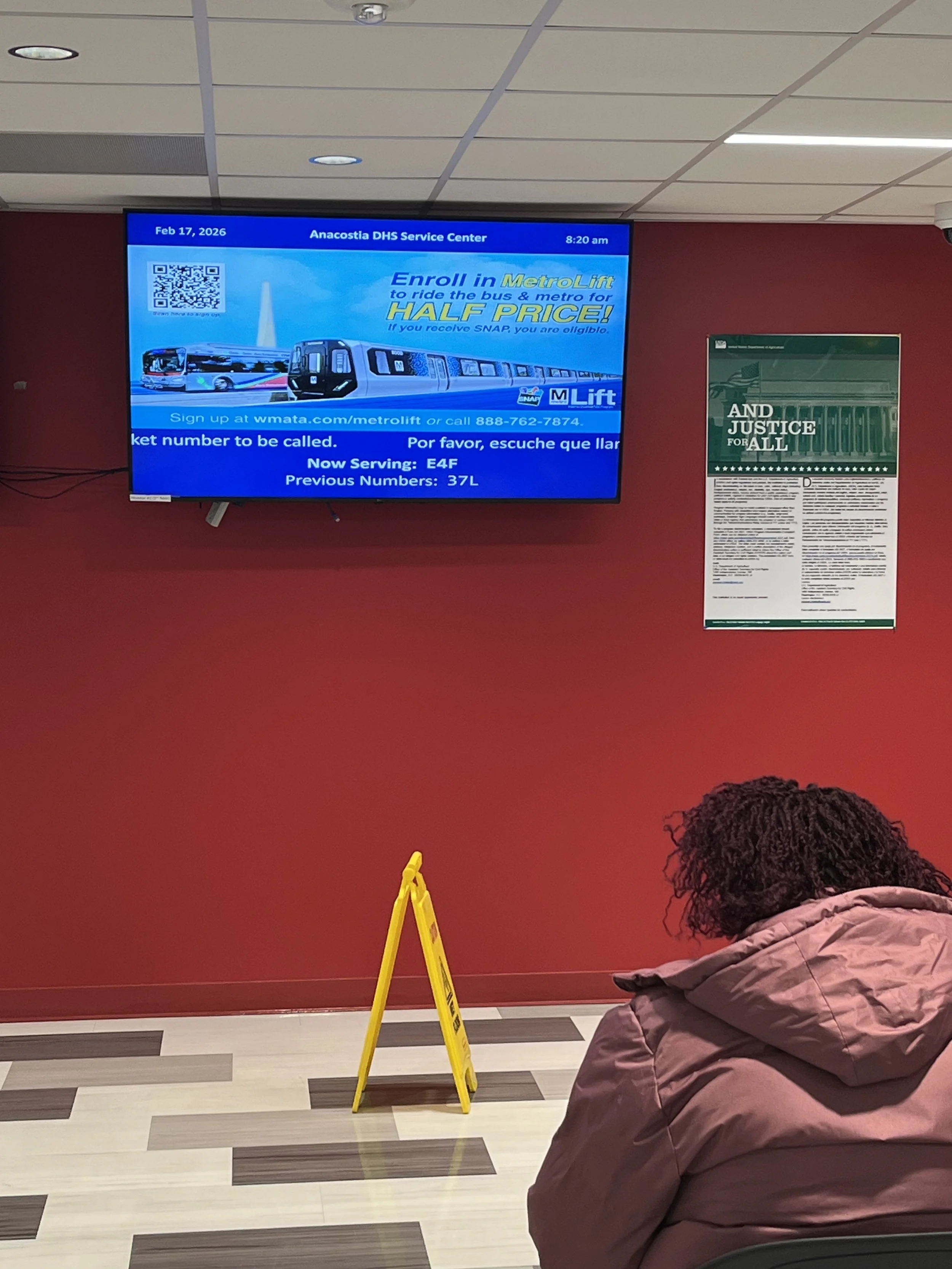
The Metro Lift screen design on display in the waiting area at the Anacostia Department of Human Services (DHS) service center. (Photo credit: SNAP Employment and Training team).
Why is this issue important in DC?
Low-income DC residents who get discounted transit fares take more trips and report higher levels of satisfaction with their lives compared to those paying full price.2 However, participation in Metro Lift is quite low. As of April 2025, fewer than 10% of eligible DC residents had enrolled.3
This gap means that people’s benefits aren’t going as far as they could. DHS’s SNAP Employment and Training program (SNAP E&T) gives participants pre-loaded transit fare cards to help them travel to services. Unfortunately, most participants don’t know they can apply the Metro Lift discount on these cards. Doing so would effectively double the pre-loaded amount, making a $30 card worth $60.
What did we do?
The Lab developed and distributed three outreach materials designed to increase awareness about the program and help more people sign up for Metro Lift:
- A slide to be shown on screens in the waiting areas of DHS day centers, shelters, and service centers.
- A page for SNAP E&T’s weekly e-newsletters for SNAP customers.
- A step-by-step sign-up guide for SNAP E&T staff to help assist customers when they give out pre-loaded fare cards.
Lab staff user tested each material with 20 different residents at two unique DHS service centers in the District. In total, 60 customers participated. What we learned helped us improve the design and wording used in each. We then sent the final user-tested materials to Metro for branding edits.
Additionally, we met with SNAP E&T program management to raise staff awareness of Metro Lift, talk through the sign-up guide, and explain how to transfer funds to a Metro Lift-registered card. This information was then shared with the broader SNAP E&T team to better support their staff and customers.
What have we learned?
The final outreach materials were edited based on the following takeaways from our user testing. These takeaways closely align with well-established principles of human-centered design:
1. People are particularly drawn to pictures, so it’s important to make sure that images share the right message to avoid confusing people.
- Example from our user testing: A photo of a family holding groceries in front of a bus caused many participants to believe Metro Lift provided transportation specifically to grocery stores, so we incorporated a picture of a train.
2. Active, present tense language is simpler and more direct.
- Example from our user testing: “Enrolled in SNAP?” was often misread as “Enroll in SNAP!” This caused some participants to lose interest and say, “I already have [SNAP],” as they thought they already received all the benefits being advertised.
3. Logos matter, so be intentional about which ones are present, where they are positioned, and their size.
- Example from our user testing: The SNAP logo was originally quite large and placed in the middle of the designs, which led most customers to assume that Metro Lift was a new benefit provided by SNAP rather than by Metro.
4. Name recognition is important, so mention the program specifics clearly.
- Example from our user testing: Early designs had “Metro Lift” in the corner, prompting questions like “What is this program called,” even after participants fully reviewed outreach material.
Additionally, when asked, not many eligible participants saw themselves as transit users. This led us to frame the outreach materials in a way that appeals to the spectrum of new, infrequent, and existing transit users. Feedback also suggested value in advertising outside of transit spaces, so eligible residents who don’t yet regularly use public transit would still see Metro Lift outreach materials in spaces they more frequently visit.
“Oh hell yeah! I need this.”
What comes next?
DHS is using the materials The Lab created at its service centers and in other SNAP customer communications. DHS also plans to make the materials available in its shelters and day centers for families, individuals, and youth experiencing homelessness. We are monitoring enrollment data, so we can better track how many people signed up for Metro Lift after DHS outreach materials went live. This will give us information about how DHS outreach compares to other outreach efforts.
Metro is considering adapting some of the user-tested language and formatting suggestions from our findings to their own Metro Lift outreach materials. We are also coordinating with DHS and Metro to facilitate monthly in-person enrollment days at service centers and other potential locations.
1 Bureau of Labor Statistics. Consumer Expenditures – 2024. (2025)
2 The Lab @ DC. Do free and discounted fares increase transit use, well-being, and employment for low-income residents? (2025)
3 Tom Friedl. Metro offers reduced fares for low-income riders, but there's not many takers. The 51st. (2025)