
An open-source screener that other jurisdictions can use to help their residents navigate SNAP, Medicaid, and TANF work requirement exemptions
December 2026
Background
When Congress passed H.R.1—often referred to as the One Big Beautiful Bill—in 2025, many Americans receiving Medicaid and SNAP became newly subject to work requirements.
Here in DC, about 40% of our residents count on Medicaid for their health insurance. Twenty percent count on SNAP to buy groceries, and thousands count on TANF to support their children. With all three programs now requiring compliance with work rules, we knew we needed to help residents navigate them. One of our approaches—an interactive screener.
Together, the Department of Health Care Finance (DHCF), The Lab @ DC, and the Department of Human Services (DHS) designed and developed a screener that helps Washingtonians easily understand which work requirements they likely need to meet across all three programs.
We know other jurisdictions are facing the same challenge, which is why we are open sourcing our screener.
About this resource
This document outlines the design decisions we made in the screener, provides its 20 questions and 14 tailored results messages, and notes the logic used to branch users through the screener and deliver them tailored results. The open-source code[MK(1] for the screener is published on The Lab’s Github.
Our intention in providing this resource is to give you the tools to easily repurpose DC’s screener for your own jurisdiction. There may be design decisions we made that you choose to make differently. That’s ok. By seeing how we arrived at our decisions we hope this aids you in making decisions that work best for your residents and administration.
Our design decisions
Our top priority in the screener’s design is to be clear, concise, and human-first. Because we’re distilling complex regulations for three federal benefit programs, that quickly gets difficult. Questions can get lengthy and potentially insensitive. We therefore made the decision that the screener is not meant to be a formal determination. It is a best approximation. And we tell users this so that there are no surprises when they renew their benefits.
At most, a user will be asked 20 questions, but many will encounter fewer. That’s because the screener uses logic to skip over questions not relevant to the user based on previous answers.
The language throughout the screener is plain and conversational. Most questions ask for a yes or no answer, making them easy to comprehend. We do not use program jargon like “General Work Requirements” or “Able-Bodied Adults Without Dependent,” where we can avoid it. Instead, we account for these subtleties in the language we use in the results.[1] We intentionally frame results as, “you probably do (not) need to meet work requirements to keep your benefits,” rather than say “you are probably exempt from work requirements.” In our user testing with District residents receiving public benefits we found that many did not understand the term “exempt” or “exemption.”
Because exemptions are not uniform across all three programs, the screener is built to deliver “result cards” for each individual benefit program (i.e. one for SNAP, one for Medicaid, and one for TANF). This makes it clear for users to know which programs they are exempt for and which they are not. Similarly, the screener lists all the reasons the user is exempt instead of jumping straight to the results page(s) when they meet an exemption. This way the user can see a complete list of their exemptions and understand how that could impact their benefits as life factor change over time. The only exception to this rule is if someone is ≥ 65 years old or Native American. In those cases, the screener jumps straight to the results page since these are permanent exemptions.
The questions are organized in two parts—part one asks about conditions that would deem the user exempt—and part two asks about ways in which the user could already be meeting work requirements. There is a built-in off-ramp between part one and two. If the user meets exemptions they moved to the results page that tells them, “you probably do not need to meet work requirements to keep your benefits.” If no exemptions are indicated in part one, then part two tries to identify if the user is meeting work requirements and then delivers a results page that tells them, “you probably do need to meet work requirements to keep your benefits. From what you’ve shared, you are likely already meeting them;” or “…from what you’ve shared, you are not there yet, but you still have time to prepare.”
If a condition/situation is very likely to lead to an exemption, the screener treats it as an exemption. Where this shows up:
While chronic homelessness, drug or alcohol dependence, or DV-related trauma can be evidence of being physically or mentally unfit for work, the fact that the individual is homeless, struggling with drugs or alcohol, or experiencing DV is not the reason they are exempt from TANF work requirements.
The screener tells 16- and 17-year-olds receiving TANF that they are exempt based on age. Most of the time, this will be true, but if the 16- or 17-year-old is the head of household (i.e. emancipated), then they would not be exempt based on age.
To flag a potential pregnancy exemption the screener asks, “are you pregnant?” and “have you been pregnant in the last 12 months?” Together these two questions accurate capture results for most individuals, but not all. This is because there are multiple differences amongst Medicaid, SNAP, and TANF in how they count pregnancy as an exemption:
TANF – Exempt if you are in the 2nd or 3rd trimester and up until you are no longer pregnant. However, if you deliver and keep the baby, then you are exempt while caring for the child while they are under 12 months old if you area a single parent.
Medicaid – Exempt if you are in any trimester as well as 12 months after the pregnancy regardless of how the pregnancy ends (e.g a delivery, an abortion, a miscarriage, a still birth) or if you keep the baby.
SNAP – Exempt if you are in any trimester up until you are no longer pregnant. However, if you deliver and keep the baby, then you are exempt while carrying for the child while they are under 6 years old (GWR) and under 14 years old (ABAWD)
To accurately account for every edge case, we need to ask a lot of questions… and to our point earlier, most of these would be invasive and insensitive (e.g. How far along are you? Are you planning to keep the baby? Did you lose the pregnancy?) Because the screener is not giving someone an official determination, we decided that those questions are best suited for a case worker to discuss with the individual one-on-one when they come in for benefit renewal.
The results page can get lengthy, especially if a user is receiving all three benefit programs. To make it less overwhelming and focus the user, we utilize accordions to condense text under headings like, “when does this take effect?” and “what do I need to do?”
We are grateful to Code for America for their SNAP Work Requirements Screener. It guided the development of many of the questions in our screener.
[1]For example, in the case where a resident is exempt under ABAWD, but not under GWR, they receive a message that tells them they are exempt from work requirements, “however, please know that you could lose your SNAP benefits if 1) you are offered a suitable job and you turn it down, or 2) you quit the job you have or reduce your hours below 30 per week without a valid reason.
| Question | Question displays for: | Medicaid work exemption | SNAP work exemption | TANF work exemption |
|---|---|---|---|---|
|
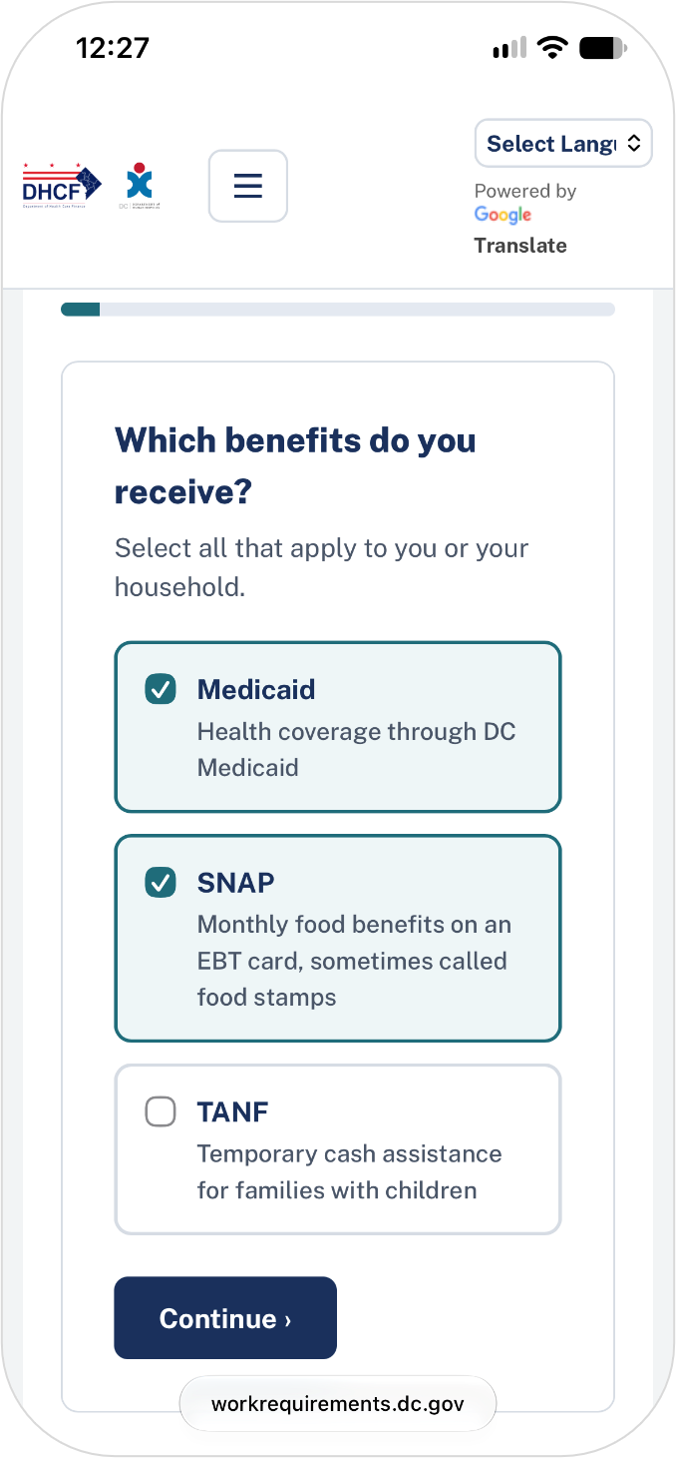
Which benefits do you receive? Select all that apply to you or your household.
|
All users | NA | NA | NA |
|
How old are you? |
All users |
Under 19 65 or older |
Under 18 65 or older |
Under 18 60 or older |
|
Jump to results
The user will be jumped straight to the results page if at this point they have told us:
If not, the user will be directed to the next question. |
||||
|
Have you aged out of foster care?
|
User is receiving Medicaid between the ages of 21-25 | Yes | No | No |
|
Are you an American Indian, Urban Indian, or California Indian? Select “Yes” if you know you are eligible for Indian Health Services.
|
User is receiving Medicaid and SNAP | Yes | Yes | No |
|
Jump to results
The user will be jumped straight to the results page if they are an American Indian, Urban Indian, or California Indian and are only receiving Medicaid. If not, the user will be directed to the next question. |
||||
|
Is there a child under the age of 14 who lives in your household? You do not have to be the child’s parent, be responsible for the child, or be their legal guardian. If you live with the child, select “Yes.”
|
User is receiving Medicaid and SNAP | Yes | Yes | No |
|
Do you care for someone who cannot care for themselves? Caring for someone means you are responsible for day-to-day tasks like making food, bathing and personal care, running errands, and monitoring their health and wellbeing. The person does not need to live with you. Choose all that apply.
|
All users |
Person who is ill/ disability Child under 6 |
Person who is ill/ disability Child under 6 |
Person who is ill/ disability |
|
Are you pregnant?
|
All users | Yes | Yes | Yes (2nd and 3rd trimester only) |
|
Were you pregnant in the past 12 months?
|
User is receiving Medicaid and is not pregnant | Yes | No | No |
|
Are you a single parent caring for a child less than 12 months old?
|
User is receiving TANF and was either pregnant in the past 12 or is caring for a child under age 6 | NA | NA | Yes |
|
Are you receiving any of these disability benefits? Choose all that apply.
|
All users | All listed except “none” | All listed except “none” | All listed except “SSDI” and “none” |
|
Are any of these things preventing you from working? We know these are sensitive topics. Sharing this information could help you get ready to show that you do not have to follow work requirements. If you need help with any of these challenges, you can call 211 or look for resources at LinkU. Choose all that apply.
|
All users | Medical condition |
Medical condition Homelessness Drugs or alcohol Domestic violence |
Medical condition Drugs or alcohol Domestic violence Childcare |