
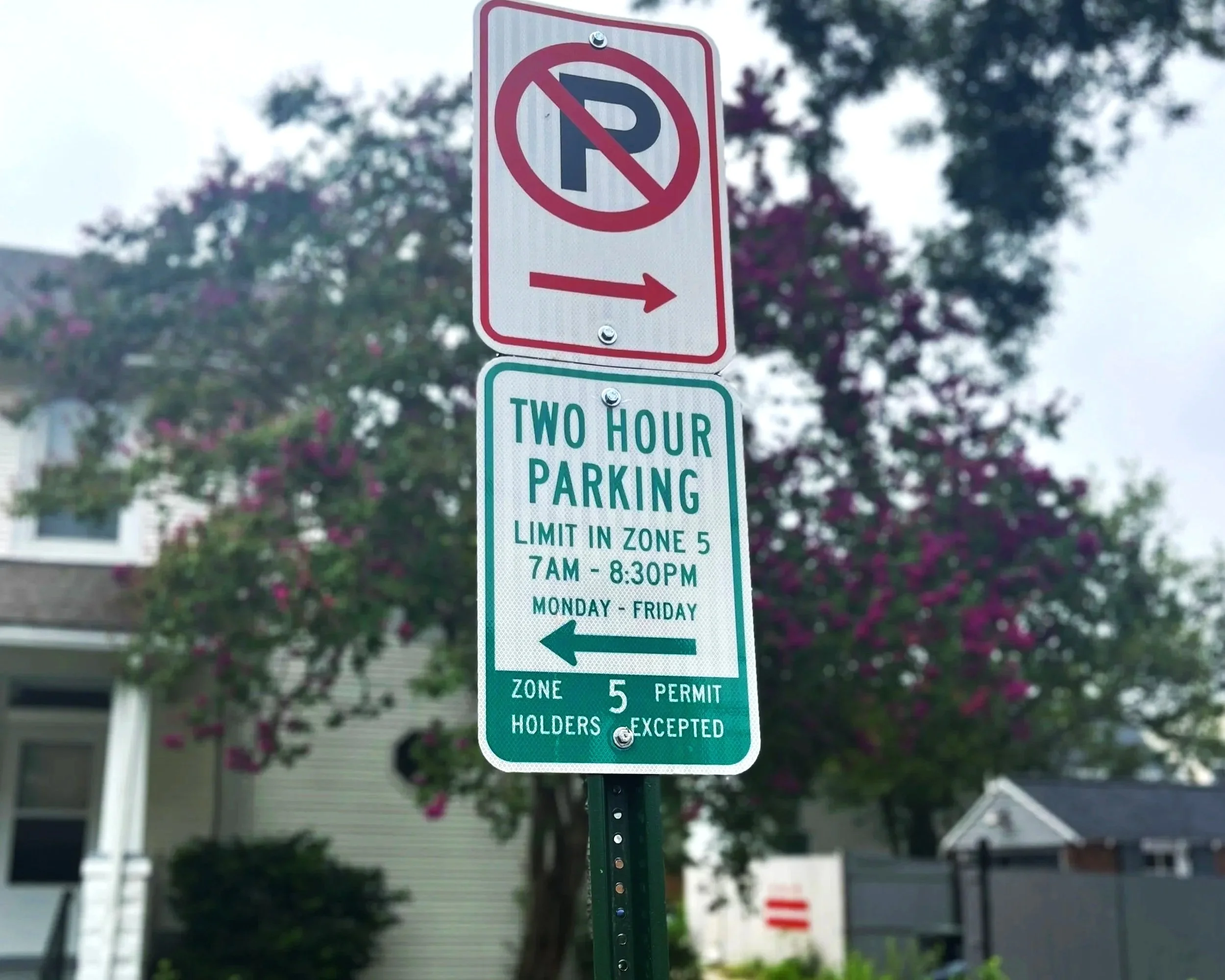
When residents struggle to find street parking near their home, it can be frustrating. It can also increase neighborhood traffic, safety hazards, and make getting home hard for people with mobility challenges. We used data on permits, meters, and other sources of parking supply and demand information to identify the areas of DC that are under high parking stress. Stakeholders helped us understand potential policy solutions to ease demand in high-stress areas, and we modelled what putting some of those ideas into practice might look like. This project will inform how DC manages, and potentially updates, the residential parking permit (RPP) program.
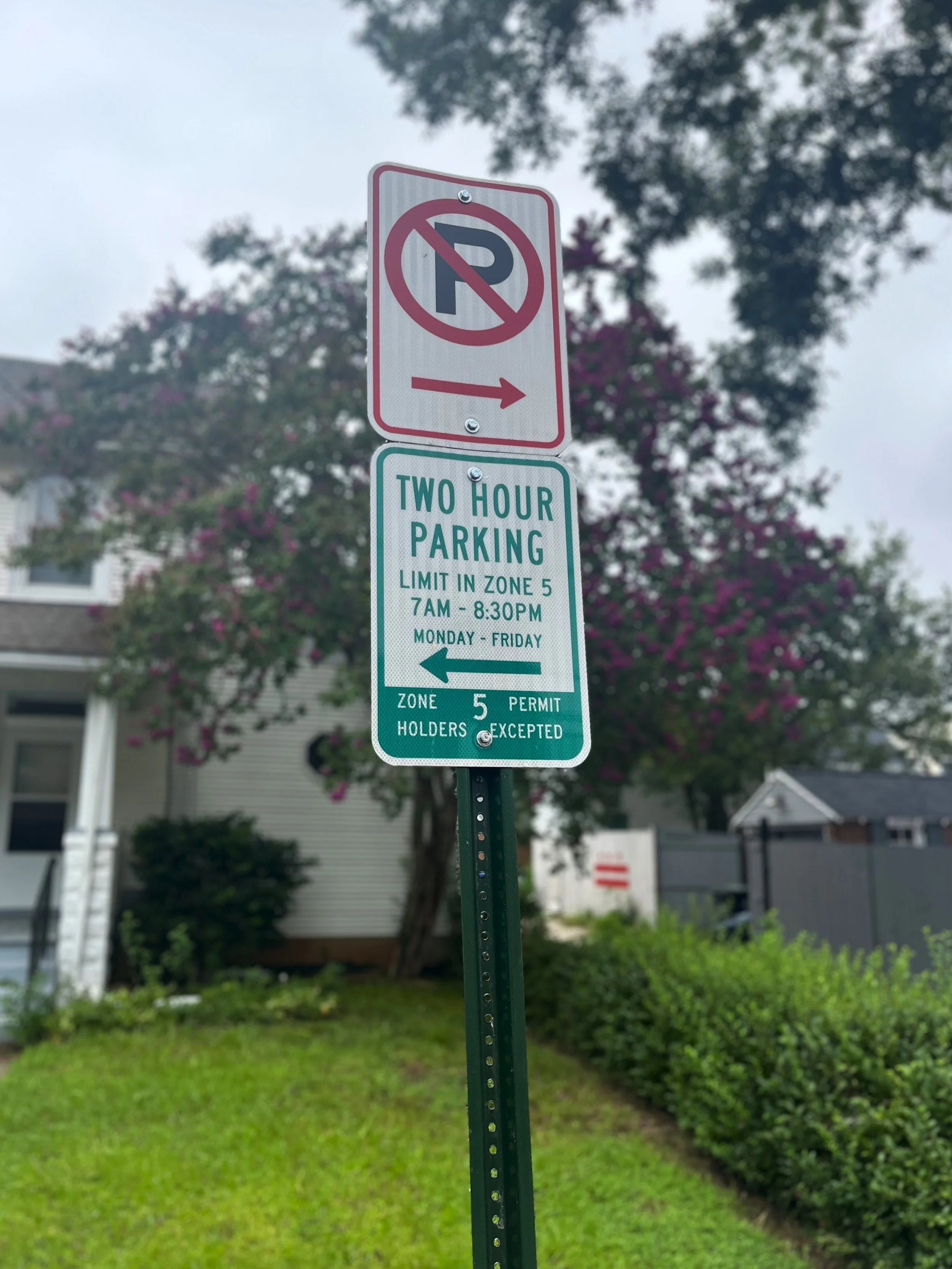
A residential parking permit sign. (Photo credit: The Lab @ DDOT)
Why is this issue important in DC?
Currently, DC vehicle owners can buy a residential parking permit if they live on an eligible street. These permits allow them to park on signed or designated RPP blocks in their zone without time limits. DC has eight residential parking zones that generally follow ward boundaries. Drivers without a residential permit can pay to park, park up to a time limit (such as two hours), or get a visitor permit from a resident.
In some neighborhoods, demand for street parking exceeds available residential spaces. For example, in 2022, 4,200 cars belonging to Dupont Circle residents had permits, but the neighborhood only had 2,500 residential spaces on the street.1 That means that, even when they have permits, residents may have to park far away from their homes, compete for parking spaces with non-residents, and/or pay for off-street parking. This can cause traffic congestion and illegal parking, which is unsafe for pedestrians, cyclists, and bus riders.2
What did we do?
This project sought to identify areas experiencing high parking stress by looking at how drivers use existing parking spaces. First, we calculated the number of residential parking spaces on each block—this is the supply. Our supply calculation drew from data on parking policies. Second, we estimated how many drivers want to access on-street parking spaces on each block—this is the demand. Our demand estimate combined data on permits and metered parking, as well as land use and zoning characteristics. We validated our analysis with quantitative and qualitative data on residential parking complaints. Together with stakeholders, we also identified possible solutions that improve parking efficiency while balancing other curbside priorities like commercial loading and bus boarding.
What did we learn?
We found that smaller parking zones, a frequently suggested solution, would not reduce parking stress. This is because in many parking "hot spots", the District issues more permits than there are available on-street parking spaces. If the zones were smaller, the same residents would compete for less space. Not everywhere is a hot spot, though: in much of the District, there is plenty of space to park. Our findings suggest that it would be better to develop tailored policies for hot spots rather than make parking policy uniform for the whole District.
We also explored expanding the RPP program's eligibility to make it fairer for residents of denser, multi-family neighborhoods. We found that expanding RPP to "mixed-use" zones would add about 5,000 (3.5%) new permits to DC, but mostly in areas where parking stress is currently low.
What comes next?
We identified some data-driven opportunities where DDOT can focus its efforts to make it easier to park in the full report. We shared our findings with leadership at DDOT. This research relied on indirect sources (311 data and the community engagement specialists) for community input. Before making changes to the RPP program, more robust community engagement is needed. What we learned may shape ongoing discussions about changes to the residential parking permit system.
1 District Department of Transportation. “Innovative Parking Practices on Residential Streets Study FY 2021-2022.” Report to Council. Washington, DC, August 2022.
2 Kittelson & Associates, Inc. “Penn Quarter/Chinatown Parking Pricing Pilot.” Report to the District Department of Transportation. Washington, DC, January 2019.