
The District regularly makes changes to streets to promote safe travel choices for all, enhance accessibility and manage congestion, and support environmental goals of reduced emissions and strengthened resilience.1 These “corridor improvement projects” can impact how many people visit an area, how they get there, what they do when there, and how safe they are on those trips. We will study the impacts of corridor improvement projects using a quasi-experimental method. Understanding these impacts will help the District make sure that roadway and public space changes meet the needs of residents and business communities.
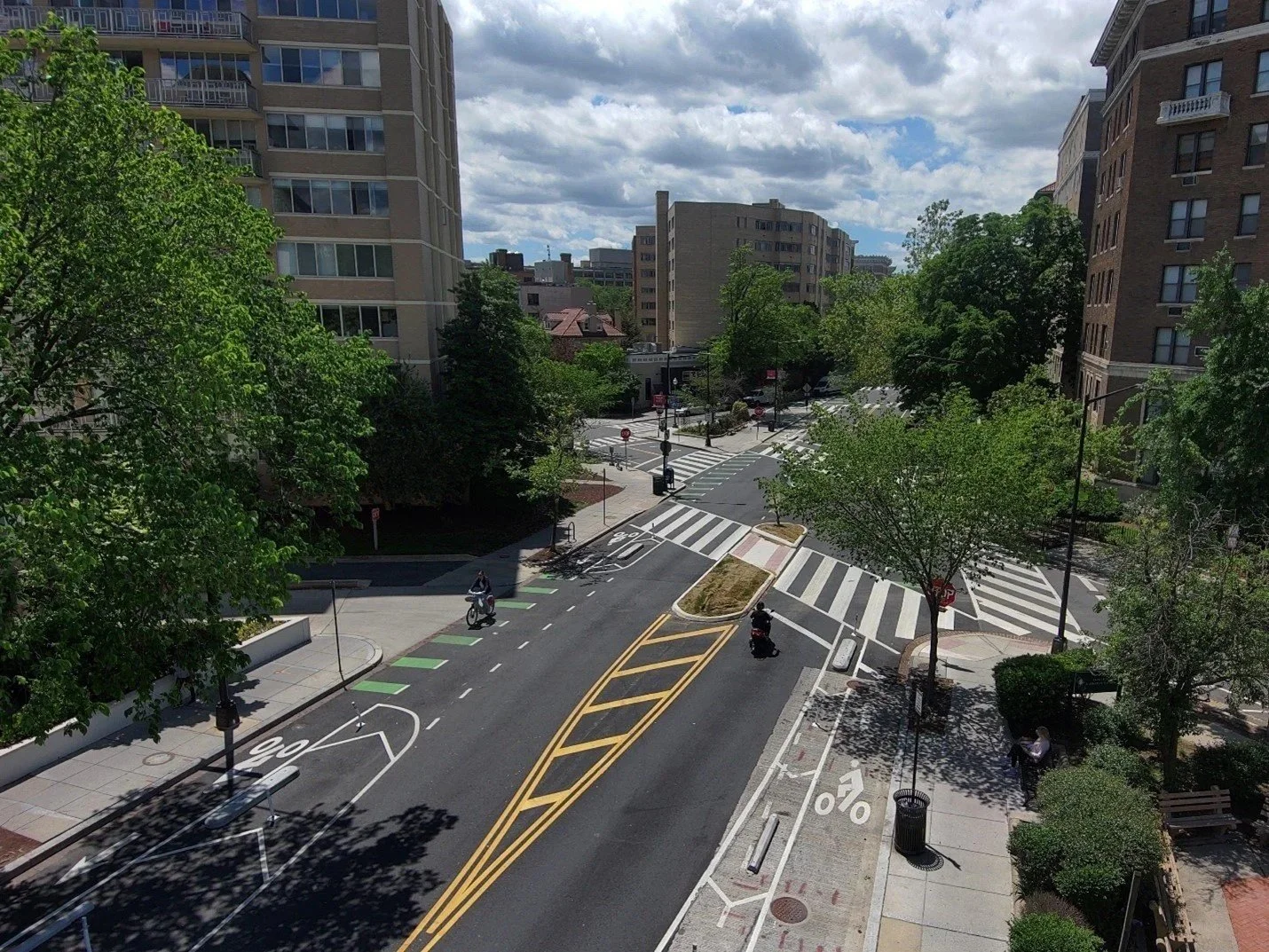
Protected bike lane and pedestrian refuge on Columbia Rd NW at 19th St NW. (Photo credit: DDOT)
Why is this issue important in DC?
One of the primary ways that the District Department of Transportation (DDOT) achieves its goal of a safe, sustainable, and reliable multimodal transportation network is through corridor improvement projects. These projects may narrow driving and parking lanes and widen sidewalks—improving intersection safety—or introduce bus lanes, bike lanes, and other features. In 2024, DDOT started sharing snapshots of a few metrics measured before and after these projects get implemented—such as crashes, vehicle speeds, and traveler volumes—as a way to track progress toward the agency’s goals.
2
But residents and business owners want more information about the potential economic effects of corridor projects, especially when changes reduce street parking.
What are we doing?
Building on DDOT’s existing evaluations, we plan to study a recently completed corridor improvement project with added economic outcomes like nearby businesses’ retail sales. We will also apply a
quasi-experimental method
called a ‘synthetic control’. In this method, we will combine several data sources about corridors all over the District to create a comparison corridor. We will then compare the outcomes from the study corridor against the comparison corridor. This method takes into account everything else that’s going on in the District that might influence economic, travel, and safety outcomes. This is particularly important for studying economic changes because it can account for city-wide changes like a recession or a boost in tourism. Following our analysis, we plan to build a framework that DDOT can use to apply this approach to other projects in the future.
What have we learned?
We expect results by late 2026.
What comes next?
Results from this work will inform how corridor improvement projects are evaluated in the future and may help DDOT more holistically consider past project impacts when directing future investments in public space.
“Mayor Bowser’s historic investments in corridor safety improvements across the District have enabled DDOT to redesign streets in ways that measurably improve safety, accessibility, and mobility. These projects have allowed DDOT to transform our streets into safer, more accessible spaces for pedestrians, cyclists, transit riders, and everyone moving around DC.”
1 MoveDC - The District of Columbia’s Multimodal Long-Range Transportation Plan. Accessed December 2025.
2 Virginia Avenue NW. Analysis Overview. (2024).